Synesthesia is a neural condition that tangles the senses.

So, for example, a person can hear colors and taste words. It can bind any two senses, but research has focused on the two most common ones (auditory tones and colorless numbers which can produce very vivid colors). The evoked colors remain stable for the person. Examples
For Synesthetes, hearing particular sounds might stimulate particular shapes, tasting
flavors may give sensations to certain objects, and different textures may give
specific emotions. Synesthetes are very particular about their associations,
for example, a “J” is not just orange but a dull orange.
The first notations of synesthesia were seen by Sir. Francis Galton (who was Charles Darwin’s cousin) in the 19th century. He was the first to propose that this condition runs in families. Other scientists believed that it was a form of mild insanity. Over the years it was
shown that synesthesia has a physical basis- the brains of synesthetes are
wired differently. Up till now, at least 60 different forms of synesthesia has
been documented.
In a number of PET scans, MRIs, and fMRIs, it has been shown the different wiring takes
place in the left hemisphere of the brain in a number of visual cortex areas. Each
 area is responsible for a numbers of functioning such as; motion, direction,
color, and perception. In a synesthete, these areas are cross-activated.
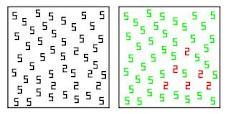
There were findings that suggest that Synesthesia was Perpetual. Neuroscientist, Vilayaneur S. Ramachandran MD, PhD and Arman Hubbard MD PhD used tests that included pop out displays of 2’s and 5’s. It is slightly difficult to point out the 2’s and
the 5’s for nonsynesthetes; however, there are corresponding colors for the
synesthetes.
Synesthesia tends to run in families. Around 40% of synesthetes report a close relative with the condition. Pedigree anaylsis
suggest high transmissibility between parent to offspring. The 60 different
forms of synesthesia could be formed from a unique set of genes or set of
genes. Studies have shown that with every 6 females 1 male has the condition
which suggests that this trait is X-linked.
There is one controversial theory as to how synthesia is made. Since it is suggested that the trait comes from a mutated gene on the X chromosome, in the “neonatal hypothesis” it is suggested
that all people were born with the mismatched connections of synesthesia, however
the connections were destroyed in a pruning process that was caused during infanthood.
In synesthetes, the single gene mutations causes the lack of pruning.
So, why did this gene survive?
This trait could have a hidden
agenda like the sickle-cell anemia gene which had malaria resistance. It was
shown that a larger portion of synesthetes are artists and writers than
nonsynesthetes which suggests a higher understanding of metaphor, which is a
key to knowledge, and therefore, survival. This “creativity and metaphor” was
suggested by Ramachandran and Hubbard. The nature between the link of
creativity and synesthesia remains questionable, however synesthesia is shown
as associating two unrelating things. The basis of metaphor is strong in all of
us, but is stronger in a synesthesia because of the cross-activation gene.
The benefits of Synesthesia
A well-characteristized savant, Daniel Tammet has demonstrated his remarkable memory abilities with using his synesthesia. http:/http://www.youtube.com/watch?v=Pzd7ReqiQnE/(Youtube Video of Daniel Tammet). Tammet can memorize pi to 22, 514 digits. http://http://www.youtube.com/watch?v=hkHyhbz1MME (Another Video of his abilities)
A well-characteristized savant, Daniel Tammet has demonstrated his remarkable memory abilities with using his synesthesia. http:/http://www.youtube.com/watch?v=Pzd7ReqiQnE/(Youtube Video of Daniel Tammet). Tammet can memorize pi to 22, 514 digits. http://http://www.youtube.com/watch?v=hkHyhbz1MME (Another Video of his abilities)
Synesthetes have increased processing of color information, but this is not due
to the synthesthesia itself, but to the synesthesia’s excessive experience with
colors. Synesthetic experiences may serve as cognitive and perpetual anchors to
aid in the detection and processing of critical stimuli. It also suggests that synesthesia
may be associated with enhanced primary sensory processing as well as
integration between the senses. Synesthetes also show increased communication
between the senses unrelated to their synesthetic experiences which shows the
ability to process multisensory information.
“Nature reveals herself through
exceptions. Those objectivists who tried to dismiss synesthesia throughout
history seem to have forgotten this maxim. Far from being a mere curiosity
irrelevant to real questions, synesthesia turns out to illuminate a wide swath
of mental life and forces us tore think some fundamental issues regarding mind
and brain.”
-Richard E. Cytowic
to the synthesthesia itself, but to the synesthesia’s excessive experience with
colors. Synesthetic experiences may serve as cognitive and perpetual anchors to
aid in the detection and processing of critical stimuli. It also suggests that synesthesia
may be associated with enhanced primary sensory processing as well as
integration between the senses. Synesthetes also show increased communication
between the senses unrelated to their synesthetic experiences which shows the
ability to process multisensory information.
“Nature reveals herself through
exceptions. Those objectivists who tried to dismiss synesthesia throughout
history seem to have forgotten this maxim. Far from being a mere curiosity
irrelevant to real questions, synesthesia turns out to illuminate a wide swath
of mental life and forces us tore think some fundamental issues regarding mind
and brain.”
-Richard E. Cytowic


