Showing posts with label brain. Show all posts

Tuesday, December 27, 2011

The Enigma of Synesthesia


Synesthesia is a neural condition that tangles the senses.
So, for example, a person can hear colors and taste words. It can bind any two senses, but research has focused on the two most common ones (auditory tones and colorless numbers which can produce very vivid colors). The evoked colors remain stable for the person. Examples
For Synesthetes, hearing particular sounds might stimulate particular shapes, tasting
flavors may give sensations to certain objects, and different textures may give
specific emotions. Synesthetes are very particular about their associations,
for example, a “J” is not just orange but a dull orange.
The first notations of synesthesia were seen by Sir. Francis Galton (who was Charles Darwin’s cousin) in the 19th century. He was the first to propose that this condition runs in families. Other scientists believed that it was a form of mild insanity. Over the years it was
shown that synesthesia has a physical basis- the brains of synesthetes are
wired differently. Up till now, at least 60 different forms of synesthesia has
been documented.
In a number of PET scans, MRIs, and fMRIs, it has been shown the different wiring takes
place in the left hemisphere of the brain in a number of visual cortex areas. Each
area is responsible for a numbers of functioning such as; motion, direction,
color, and perception. In a synesthete, these areas are cross-activated.
There were findings that suggest that Synesthesia was Perpetual. Neuroscientist, Vilayaneur S. Ramachandran MD, PhD and Arman Hubbard MD PhD used tests that included pop out displays of 2’s and 5’s. It is slightly difficult to point out the 2’s and
the 5’s for nonsynesthetes; however, there are corresponding colors for the
synesthetes.
Synesthesia tends to run in families. Around 40% of synesthetes report a close relative with the condition. Pedigree anaylsis
suggest high transmissibility between parent to offspring. The 60 different
forms of synesthesia could be formed from a unique set of genes or set of
genes. Studies have shown that with every 6 females 1 male has the condition
which suggests that this trait is X-linked.
There is one controversial theory as to how synthesia is made. Since it is suggested that the trait comes from a mutated gene on the X chromosome, in the “neonatal hypothesis” it is suggested
that all people were born with the mismatched connections of synesthesia, however
the connections were destroyed in a pruning process that was caused during infanthood.
In synesthetes, the single gene mutations causes the lack of pruning.

So, why did this gene survive?

This trait could have a hidden
agenda like the sickle-cell anemia gene which had malaria resistance. It was
shown that a larger portion of synesthetes are artists and writers than
nonsynesthetes which suggests a higher understanding of metaphor, which is a
key to knowledge, and therefore, survival. This “creativity and metaphor” was
suggested by Ramachandran and Hubbard. The nature between the link of
creativity and synesthesia remains questionable, however synesthesia is shown
as associating two unrelating things. The basis of metaphor is strong in all of
us, but is stronger in a synesthesia because of the cross-activation gene.
The benefits of Synesthesia

A well-characteristized savant, Daniel Tammet has demonstrated his remarkable memory abilities with using his synesthesia. http:/http://www.youtube.com/watch?v=Pzd7ReqiQnE/(Youtube Video of Daniel Tammet). Tammet can memorize pi to 22, 514 digits. http://http://www.youtube.com/watch?v=hkHyhbz1MME (Another Video of his abilities)
Synesthetes have increased processing of color information, but this is not due
to the synthesthesia itself, but to the synesthesia’s excessive experience with
colors. Synesthetic experiences may serve as cognitive and perpetual anchors to
aid in the detection and processing of critical stimuli. It also suggests that synesthesia
may be associated with enhanced primary sensory processing as well as
integration between the senses. Synesthetes also show increased communication
between the senses unrelated to their synesthetic experiences which shows the
ability to process multisensory information.

“Nature reveals herself through
exceptions. Those objectivists who tried to dismiss synesthesia throughout
history seem to have forgotten this maxim. Far from being a mere curiosity
irrelevant to real questions, synesthesia turns out to illuminate a wide swath
of mental life and forces us tore think some fundamental issues regarding mind
and brain.”
-Richard E. Cytowic

Friday, December 16, 2011

The Brain of a Psychopath


Psychopathy is a mental disorder generally defined primarily by a lack of empathy and remorse, egocentricity, and shallow emotion. Psychopaths tend to have antisocial behavior, however their abusive means are sometimes not automatically spots. Many times it can be out of secretive methods of manipulation. However, pyschopathic tendencies can be seen in childhood and early adolescence. There is a MacDonald Triad created by J.M. MacDonald in which three indicators: excessive bedwetting, cruelty to animals, and firestarting sets the standard for psychopathic behavior. Other examples could be theft, robbery, and destruction of property. For example, Charles Manson, who founded a cult group known as "The Family", manipulated the people to murder, started his first offenses commiting a string of burglaries. (in the picture)
Genetics plays a significant role in the development of pyschopathy, however the environment interacts with genetics, so genes are the not only determinant. There has been studies done on twins. One article by Dr. Essi Viding of the London Kings College Institute of Psychiatry discussed experiments done with twins. Samples of twins were investigated in a general study called Twins Early Developmental Study. Callous unemotional traits were placed on a scale by using questions relating to antisocial traits in several assessments. Another measurement, the antisocial behavior (AB) scale was also devised. Results of this study showed that callous unemotional traits are highly based on genetics. The children that showed high results in callous unemotional traits had strong genetic influence in antisocial behavior. Whereas, the children that did not test high in callous unemotional behavior showed that their antisocial behavior was more based on environment. The studies in the UK have shown that children with psychopathic tendencies are likely to have inherited in from their parents.
Brain Differences?
It has been show that psychopaths lack brain activity that has to deal with emotion, fear, and empathy. The areas include the right hemisphere, the amygdala, and the frontal cortex respectively. Psychpaths tend to respond less to fearful faces than healthy individuals.

Sunday, December 11, 2011

Synesthesia

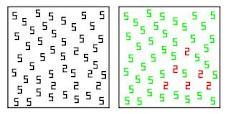
As you are reading this, I am sure most of you see this simply as a bunch of letters in a boring black color. Not very exciting. However, there are people out there who, when they read this, would see all these individual letters in different colors, each letter or number having always having a unique color.

This condition is called grapheme – color synesthesia. This form of synesthesia

is the most common, and a person with this condition is known as a “synesthete”. A synesthete with this condition associates letters and numbers with specific colors and those colors never change. If you look at this picture, on the left is how a non-synesthetic person would see the arrangement of 5’s and 2’s, and on the right would be how a person with synesthesia would see it. However, there are other forms of synesthesia as well. One other common type of synesthesia is ordinal-linguistic personification. It is less common than grapheme – color synesthesia and in this version, and instead of seeing letters and numbers with specific colors, they are seen having specific personalities.

The number of cases of people with synesthesia ranges between about 1 in every 20 to 1 in every 25,000. The disorder itself comes down to the wiring of the brain. Although not much is completely known about it, it is understood that when wires in the brain are crossed in certain ways, we end up involuntarily combining different senses or, in the case of the grapheme – color synesthesia, seeing something differently from how it actually looks. It occurs as a result of a malfunctioning pruning in the brain. Usually, pruning results in the elimination of certain connections in the brain between various regions during development. However, when this is not properly performed, the connections remain and that is when different senses are combined or there are differences within the senses themselves.

More females are affected with synesthesia than males, approximately a 6:1 ratio. However there is no surefire way to assure this is completely true for everyone because for most synesthetes, as it is something they are born with and live with (more often than not), it is perceived as completely normal for them. As a result, they may not share that they have this distinction as it does not seem like something important.

Through studies, it was noted that synesthesia was passed down through family generations. At first it was believed to be X-linked, as all studied cases of this disorder were passed down father-to-daughter, mother-to-daughter, or mother-to-son, until they found 2 cases in which it actually was passed down from father-to-sun.

So, what could be the real reason for this condition? To me, it seems to be caused by some sort of mutation in a chromosome that causes a malfunctioning enzyme that is used to get rid of unnecessary wire crossing within the brain, which would cause the failure of pruning to occur as the brain is developing, as it is often passed down through generations within families. What do you think be the reason for this?

If you want more information, you can watch one of these videos (this one or this one), or check out one of these sites (this one for synesthesia in general, and this one for more genetics based information on synesthesia).

Wednesday, November 9, 2011

How does music interact with the brain?

Hello people of the World Wide Web! Or, Mr. Hammers’ Biology classes. Okay so I know there’s not many of us music geeks out there, but here goes.

I know some of you have heard of the term right brained or left brained. For those of you who don’t, it doesn’t mean which side of the body is your strongest; it’s what side of your brain that’s the strongest. The left side is supposedly math and science and the right is art and literature and science.

I set out to find out if it’s true. The brain is ultimately divided into two hemispheres, the right and left, as I said before (picture to the right). The right is known for music but there has been no known exact music processing area found in the brain. Further research has shown that it is an interaction between both sides of the brain to process music.

Additionally, the part of the brain that has perfect pitch is also involved in speech perception. Music and other sounds entering the ears go to the auditory cortex, assemblages of cells just above both ears. The right side of the cortex is crucial for hearing pitch as well as certain aspects of melody, harmony, and rhythm. The front part of our brain where working memories are stored also helps with the perception of rhythm and melody.

Researchers have found activity in regions of the brain that control movement when people just listen to music without moving any parts of their bodies. One researcher said "If you're just thinking about tapping out a rhythm, parts of the motor system in your brain light up. Music is as inherently motor as it is auditory," he continues. "Many of us 'conduct' while listening to classical music, hum along with show tunes, or dance to popular music. Add the contributions of facial expressions, stage lights, and emotions, and you appreciate the complexity of what our brain puts together while we listen and interact with music in a concert hall or mosh pit."

Yes, this might not make complete sense right now, but think about it people! Music can practically control your emotions and movements. I find that pretty cool stuff, and if you don’t, that’s not my problem.

So continuing on, understanding the biology of music helps us use it in ways beyond entertainment. We can use it medically and in athletics.

Following heart bypass surgery, patients often have changes in blood pressure. These changes are treated with drugs. Studies show that those in intensive care units where music is played need lower doses of these drugs compared with patients in units where no music is played.

Some hospitals play soft music in care units for premature babies. This music along with a nurse’s of mother’s humming has proven to help the babies gain weight faster and get out of the unit faster than the babies that don’t listen to the music.

The stories are limitless of athletes using music to help them before a big performance. For example, Pitcher Trevor Hoffman of the San Diego Padres listens to AC/DC to get pumped for a game. To see how much difference music makes, the performance of an athlete who listens to music would have to be compared with that in games when he or she didn't listen.

If you want to look up any more info click here!

So people reading this, see how much music influences you? I bet you didn’t know some of that. So, I’m going to stop spending your time!

Keep dancing and singing like no one’s watching!

Alanna Griffin

Tuesday, November 8, 2011

What if a Drug and Reversed Wiring of the Brain could Cure an Addiction Completely?

Humans become addictive to drugs for the main reason that it give pleasure. Practically all addictive drugs give a release of dopamine which governs motivation and reward centers of the brain. However, with each use of an addictive drug, a wire is threaded into the brain. That wire connects the drug to the various list of an individual's needs and wants. With each use, the connection grows stronger, until the drug substitutes for the list. The only desire in life would be the drug. The dopamine center is short of explaining everything about the use of addictive drugs. Researchers are turning to a new brain chemical called orexin.
Researchers in the University of California are looking to the brain chemical orexin to see how it can trigger arousal and pleasure within brain circuitry. When using an experiment done with rats, giving a dose of cocaine to rats would increase the physical activity, and thus shows the increase in expression of the dependency for the drug. This is called the sensitization to the drug. But, the sensitization won't occur if the same rat given cocaine, was also given a chemical blocking the flow of orexin. This showed that blocking the flow of orexin, also caused the inability of the brain to rewire from the cocaine. Questions came from this experiment such as, What if people would still be able to take pleasurable drugs without become addictive to them? However, the chemicals to block orexin just prevent the rewiring of the brain, they do not reverse it. The scientists are aimed at how to restore connections of the brain that were previously there before drug addiction occurred. They started to look at how memory is formed within the brain. The research team in the University of California acknowledged that one way memory is form is from the slow and steady pulse to the brain in order for the circuitry to be altered. The team created a protein fragment that could change the rate of firing, thus not causing circuitry, hence, no memory was formed. The protein was given to the mice that were dosed with amphetamine and found the mice responded to the amphetamine as though they first received it. This raised the motivation within the researchers that reversed wiring in the brain could occur.
Medications on blocking orexin might be available soon according the the researchers. However, wire reversal therapy is much longer in the wait and more up to discussion.
I want your opinion to this idea of reversed rewiring of the brain, as though the drug never took an effect. Although, finding a medication that could stop addiction is one advancement, what if the wiring could be placed in reversed, as though a drug addiction never even happened?

Friday, November 4, 2011

This is your brain on sports

Interesting read from Grantland's Le Anne Schreiber on what happens inside your brain as you watch a sporting event.
http://www.grantland.com/story/_/id/7179471/this-your-brain-sports